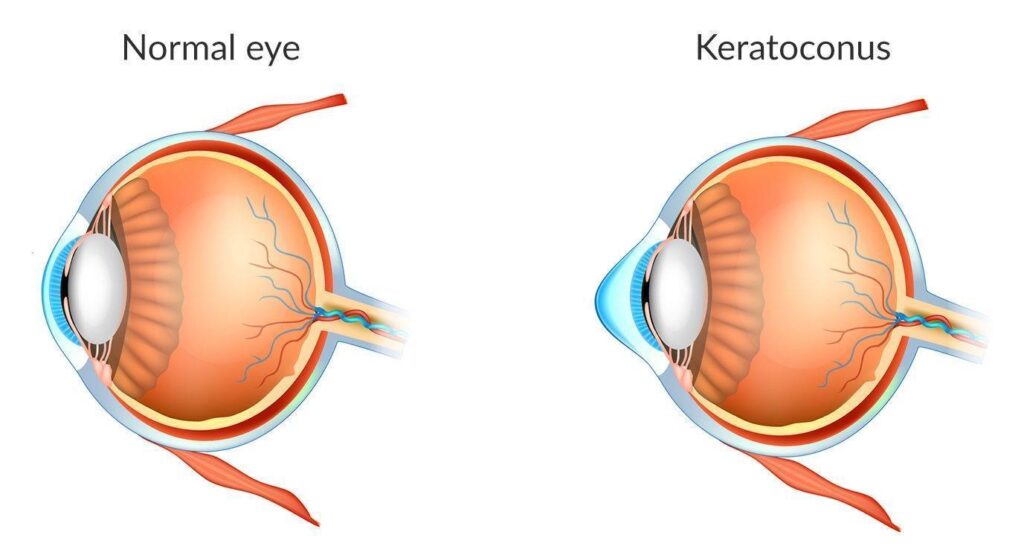
What is Keratoconus?
Keratoconus is a progressive eye condition in which the normally round cornea (the transparent front surface of the eye) becomes thin and gradually bulges outward into a cone-like shape.
This irregular shape affects the way light enters the eye, resulting in:
- Increasing spectacle power.
- Irregular astigmatism.
- Blurred or distorted vision.
- Frequent changes in glasses prescription.
- Difficulty achieving clear vision with spectacles or contact lenses.
Early diagnosis and appropriate treatment are important to preserve visual function.
What is CAIRS Treatment?
CAIRS stands for Corneal Allogenic Intrastromal Ring Segments.
It is an advanced surgical procedure in which specially prepared donor corneal stromal tissue segments are implanted within the cornea. Unlike conventional synthetic corneal ring implants, CAIRS uses biological human donor corneal tissue.
These segments help modify the corneal curvature, reduce the cone-like protrusion and improve corneal regularity. The objective is to improve the optical quality of the cornea and potentially improve vision.
How Does CAIRS Work?
During CAIRS surgery:
- Detailed corneal mapping is performed to understand the shape, thickness and location of the cone.
- A customised intrastromal channel is created within the cornea.
- Specially prepared donor corneal tissue segments are inserted into the channel.
- The segments exert a reshaping effect on the cornea, helping regularise its curvature.
The procedure is planned according to individual corneal topography and thickness.
Who Can Benefit From CAIRS?
CAIRS may be considered for selected patients with keratoconus, particularly those who:
- Have irregular corneal curvature.
- Have poor spectacle-corrected vision.
- Have difficulty tolerating contact lenses.
- Have significant corneal irregularity.
- Require corneal reshaping as part of a comprehensive keratoconus treatment plan.
Not every patient with keratoconus is suitable for CAIRS. Detailed corneal evaluation is essential before recommending surgery
CAIRS vs Conventional Synthetic Corneal Rings
One of the important differences between CAIRS and conventional intracorneal ring segments is the material used.
- Conventional ICRS: Uses synthetic implants, usually made from biocompatible polymer materials.
- CAIRS: Uses specially prepared biological donor corneal stromal tissue.
CAIRS offers the advantage of biological tissue integration and customisation. However, the choice between these procedures depends on the patient’s corneal anatomy and individual requirements
Is CAIRS Enough to Stop Keratoconus Progression?
This is an important question.
CAIRS primarily aims to improve corneal shape and visual quality. It should not be considered a substitute for corneal collagen cross-linking (CXL) when keratoconus is progressing.
Corneal cross-linking strengthens the corneal collagen structure and aims to halt or slow further progression.
Depending on the patient’s condition, CAIRS and CXL may be performed as part of a combined treatment strategy.
What Tests Are Required Before CAIRS Surgery?
A detailed corneal assessment is essential for planning CAIRS treatment.
Important investigations include:
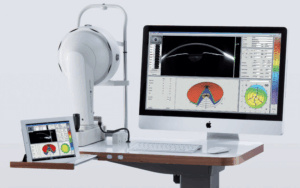
- Pentacam Corneal Tomography: Provides detailed mapping of corneal curvature, elevation and thickness.
- Corneal Pachymetry: Evaluates corneal thickness and helps assess surgical suitability.
- Refraction and Visual Acuity: Determines the extent of visual impairment and refractive error.
- Slit Lamp Examination: Evaluates corneal health and any associated scarring.
These investigations help determine the most appropriate treatment for each patient.
Can CAIRS Avoid a Corneal Transplant?
In selected patients, CAIRS may improve corneal shape and visual function and potentially delay or avoid the need for corneal transplantation.
However, it cannot replace corneal transplantation in every case.
Patients with advanced corneal scarring, severe structural damage or unsuitable corneal anatomy may require procedures such as DALK or penetrating keratoplasty (PKP).
The decision depends on the stage of keratoconus and the overall health of the cornea.
FAQ
Most Popular Questions
CAIRS involves implantation of donor corneal tissue segments into the cornea. A femtosecond laser may be used to create the intrastromal channel in selected surgical techniques.
CAIRS uses biological donor corneal tissue, whereas conventional ICRS uses synthetic materials. Both have specific indications, and suitability depends on individual corneal anatomy.
CAIRS can improve corneal regularity and may improve uncorrected and spectacle-corrected vision. The extent of improvement varies between patients.
Yes. In selected patients, CAIRS and corneal cross-linking may be combined to address both corneal shape and disease progression.
Selected patients with advanced keratoconus may benefit, but suitability depends on corneal thickness, scarring, cone location and overall corneal health.
Patients looking for keratoconus treatment in Mumbai can consult a cornea specialist at Tandon Eye Hospital, Andheri West, for detailed assessment and individualised treatment planning.